 ultimate-guide
Best Practices for Home Renovation: 2026 Guide
Table of Contents
- Start With a Renovation Plan and Clear Project Goals
- Build a Home Renovation Budget That Holds Up
- Map Your Home Renovation Timeline and Dependencies
- Use a Home Renovation Checklist Before Work Begins
- Hire a Reputable Contractor and Protect Yourself in Writing
- Handle Permits, Building Codes, and Surprises in the Walls
- Common Home Renovation Mistakes and How to Sidestep Them
- Frequently Asked Questions
Last Updated: October 17, 2026
Start With a Renovation Plan and Clear Project Goals
The best practices for home renovation begin long before demolition day, and they start with a written plan.
The homeowners who end up happiest are the ones who can answer three questions before anyone picks up a hammer: what are we changing, why are we changing it, and what does "done" look like?
Then define the project scope in plain language. "Update the kitchen" is not a scope. "Replace the cabinets, countertops, and backsplash without moving plumbing or electrical" is.
Build a Home Renovation Budget That Holds Up
A home renovation budget is not one number; it is a set of line-item estimates, a contingency allowance, and a written decision about who absorbs surprises. Build it in that order, and build it before you sign anything.
Start with a line-item estimate for every scope item, gathered from at least two contractor bids rather than guesswork. Then set a realistic budget that includes the work you actually want, not just the work you can afford today.
Where the Money Actually Goes
In a kitchen remodel or bathroom renovation, the money concentrates in a few predictable places: labor, cabinetry and millwork, tile and finishes, fixtures, and permits. Whole-house projects spread the same categories across more square footage, but the pattern holds.
A practical way to build the estimate is a three-column worksheet: scope item, low bid, high bid. Use the high bid as your working number and the low bid as your stretch target.
Size Your Contingency Before You Sign Anything
A contingency fund is money you reserve for what you cannot see yet. Old plumbing, outdated wiring, and structural issues behind the walls are the usual suspects in dated homes.
Keep the contingency in a separate account from your upgrade money. When a surprise appears, the question becomes "is this in the contingency?" rather than "can we afford this?", a far calmer conversation.
Compare Bids Apples to Apples
Bids are only comparable if they cover the same scope. Give every contractor the same written scope and the same set of drawings or specifications, then compare line by line. A bid that is dramatically lower usually reflects a missing line item, a lower-grade material, or an allowance that will be exceeded, not a better deal. Ask each bidder to itemize labor, materials, permits, and allowances separately so you can see what is actually being priced.
Plan for the Costs Beyond Construction
Construction cost is not the whole budget. Permits and inspection fees, dumpster rental and disposal, temporary storage or rental housing during construction, and a post-project cleaning or punch-list reserve all belong in the plan. These are easy to overlook and hard to absorb once the project is underway, so list them explicitly in the budget worksheet before work begins.
Map Your Home Renovation Timeline and Dependencies
A home renovation timeline is a sequence of dependencies, not a wish list of dates. Demolition cannot start before permits are issued. Cabinets cannot be installed before the walls are finished.
Build the schedule backward from your end date, then check the order of operations.
Then plan for temporary disruption. Decide where you will live, cook, and store belongings during construction, and agree on a work schedule with your contractor that accounts for noise, dust, and water shutoffs.
Use a Home Renovation Checklist Before Work Begins
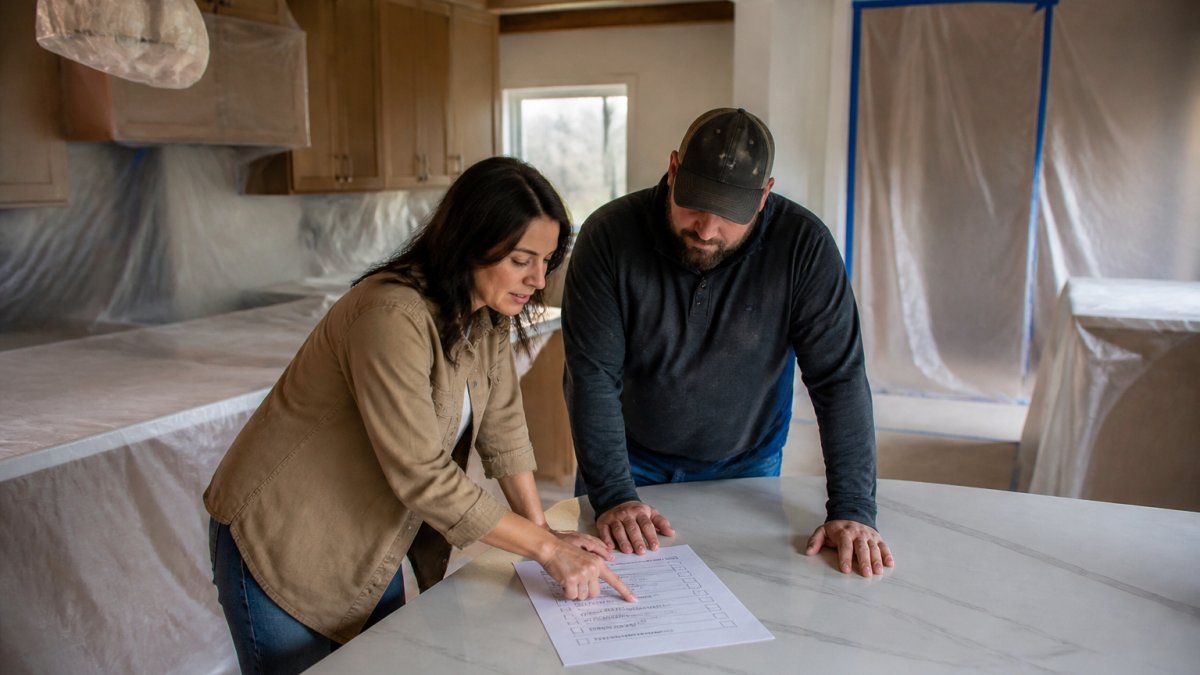
A home renovation checklist is the bridge between planning and construction. Use it in the final weeks before work starts so nothing is discovered on day one.
- Signed contract with scope, schedule, and payment terms attached
- Permits issued and posted
- Material selections finalized, with finishes and design style documented
- Lead times confirmed for cabinetry, tile, and fixtures
- Rooms decluttered and valuables stored off-site
- Furniture and flooring protected, dust barriers planned
- Water shutoff and electrical panel locations identified
- Communication schedule agreed with the contractor
- Contingency fund confirmed and separate from upgrade money
Run the checklist with your contractor present. Anything you cannot check off is a risk you are choosing to accept.
Hire a Reputable Contractor and Protect Yourself in Writing
Hiring a reputable contractor is a verification exercise, not a gut-feel decision. Ask for references from recent projects, visit at least one completed job, and confirm the contractor is licensed and insured for the work being done. Local experts who understand the climate and housing stock in your area will flag problems a visiting crew would miss.
Then put everything in writing. A verbal understanding is not a safeguard.
Verify License, Insurance, and References
Ask for the contractor's license number and confirm it with the state or local licensing authority that issues it. Ask for a certificate of insurance showing both general liability and workers' compensation coverage, and call the insurer to confirm the policy is current, a certificate can be outdated or forged.
For references, ask for three recent projects of similar scope and at least one that is more than a year old, so you can ask how the work has held up. Visit a completed job in person if you can.
Contract Terms and Payment Safeguards
The contract should state the project scope, the schedule, the payment schedule tied to completed milestones, and the process for handling change orders. Never pay the full balance up front.
Structure payments so that money follows completed work, not the calendar.
Define change orders in the contract before work begins. Every change should be documented in writing with a description, a cost, and a schedule impact, and signed by both parties before the work proceeds.
Document the Job as It Progresses
Keep a running project file: the signed contract, all change orders, inspection reports, receipts, and dated photos of each stage. If a dispute arises, this file is your evidence. If it does not, the file is your warranty and resale record. Either way, the habit costs little and protects a great deal.
Know Your Recourse Before You Need It
Ask the contractor, in writing, how disputes are handled, mediation, arbitration, or a specific process, and confirm the contractor carries the insurance required by your state or locality for the work being done. Many states require written home improvement contracts above a certain dollar threshold and give homeowners a cancellation window; confirm the requirements that apply to your project before signing. Knowing the rules in advance is what turns a contract from a formality into a safeguard.
Handle Permits, Building Codes, and Surprises in the Walls
Permits and building codes exist to protect you, and skipping them creates problems at resale. The U.S. Department of Housing and Urban Development publishes guidance on home improvement and renovation that is worth reading before you commit.
Surprises in the walls are normal in older homes. The right response is a documented change order with a cost and a schedule impact before work continues.
If aging in place is part of your long-term plan, raise it during the planning phase. Wider doorways, blocking for grab bars, and step-free entries cost far less to add during a renovation than to retrofit later.
Common Home Renovation Mistakes and How to Sidestep Them
The most common home renovation mistakes are planning failures, not construction failures. Here is how to avoid them.
| Mistake | What It Costs You | The Fix |
|---|---|---|
| No written scope | Endless change orders | Define in and out before signing |
| No contingency fund | Budget blown by hidden issues | Reserve funds before work starts |
| Paying too much up front | Lost use on schedule | Tie payments to milestones |
| Skipping permits | Resale and inspection problems | Confirm requirements first |
| Choosing finishes before layout | Rework and waste | Settle function, then finishes |
| No communication schedule | Weeks of silence | Agree on update cadence |
The pattern is consistent: the mistakes that hurt most are made before the first wall comes down. Fix them in the planning phase and the construction phase takes care of itself.
A renovation is only as strong as the planning behind it, and the hardest part is knowing which decisions matter most before the walls come down. That is where Craftsman Remodeling and Solution earns its place: we bring meticulous, custom-crafted work to every project, from custom cabinetry and millwork to full kitchen and bathroom renovations, and we communicate openly at every stage so you always know where your project stands.
Frequently Asked Questions
How do you budget for a home renovation?
Start with a total figure you can fund without straining reserves, then split it into hard costs (materials, labor, permits) and soft costs (design, inspections). Hold back a contingency of 10 to 20 percent, and lean toward the higher end for older homes where opening walls often reveals outdated wiring or plumbing. Get itemized bids rather than lump sums so you can see what each line covers. Pricing for your specific project depends on scope and materials, so request a written quote before committing.
How long does a typical home renovation take?
A single bathroom usually runs three to six weeks of construction, a kitchen six to twelve weeks, and a whole-house remodel several months or more. Those windows assume permits are already approved and materials are on site. The home renovation timeline that actually matters includes the planning phase, permit review, ordering lead-time items like cabinetry and windows, and a buffer for inspection scheduling. Ask your contractor for a schedule with named milestones and a stated end date, not just a start date.
What should you renovate first in a whole-house remodel?
Sequence by dependency, not by excitement. Structural work, roof, electrical, plumbing, and HVAC come first because everything else gets built on top of them. Insulation and drywall follow, then flooring, cabinetry, and finishes. Kitchens and bathrooms deliver the most visible return, but renovating them before the systems behind the walls are settled means paying twice. A home renovation checklist organized by phase keeps you from finishing a room and then tearing into it again.
How much contingency should you include in a renovation budget?
Plan on 10 to 20 percent of the total project cost. Ten percent is workable for a well-documented newer home with a tight scope. Twenty percent or more is prudent for older homes, projects that change the footprint, or anything where you have not yet opened walls. The contingency is not spare cash for upgrades; it is the fund that absorbs a failed inspection, hidden water damage, or a material delay. If you spend it on nicer tile, you no longer have a contingency.
How do you choose a contractor for a home renovation?
Verify licensing and insurance, ask for references from projects similar in scope to yours, and visit at least one completed job if you can. Read the contract for a written scope, a payment schedule tied to completed milestones rather than a large deposit, a change-order process, and a warranty. Ask directly how the contractor communicates during the project and who answers after the final walkthrough. A contractor who is vague about post-completion service is telling you something.
What adds the most value to a home renovation?
Kitchen and bathroom updates consistently rank among the highest-return projects, along with window replacement and improvements that raise energy efficiency. In mountain climates, insulation, air sealing, and moisture management protect the whole structure and often matter more than cosmetic finishes. Long-term value also comes from work that is done once and done correctly: proper permits, inspected systems, and durable materials. Cheap finishes over unresolved structural issues cost more later.